
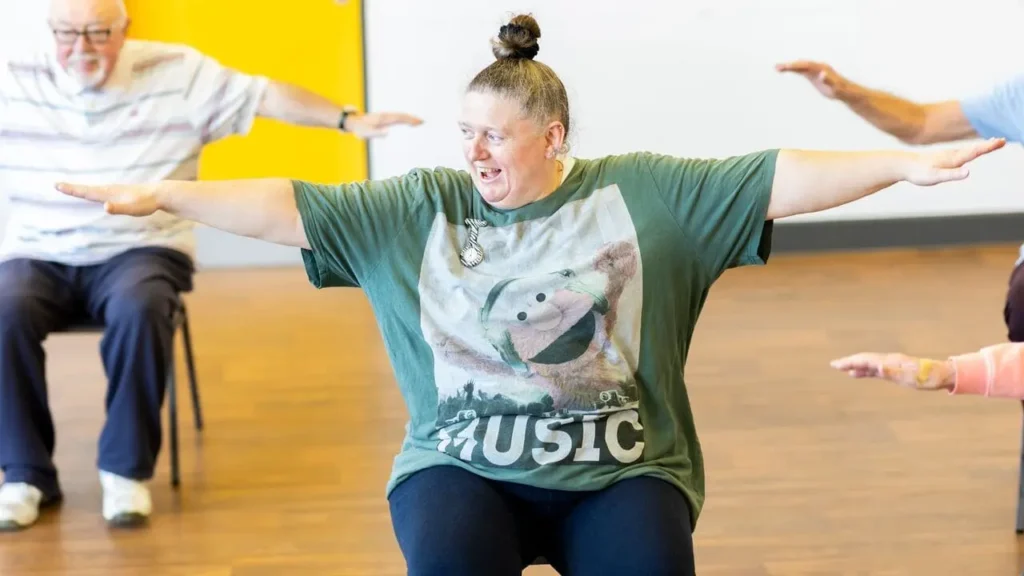
NDIS community participation cuts reduce the funding available for social, economic and community participation supports by 50%, and for improved daily living skills supports by 10%. The cut is not applied on one day. It reaches your plan when the plan is created or reassessed from 1 October 2026, or renewed from 1 February 2027.
If you use a support worker to get out to the shops, your football club, the library or a weekly class, this change matters to you. Below we set out what the government has confirmed, what stays protected, how the numbers work in practice, and what you can do now so the outings that matter most keep happening. We deliver community access and participation support across Sydney’s Eastern Suburbs, so the last part is written from the provider’s side of the conversation.
What is changing to NDIS community participation funding?
The amount available in your plan for two groups of supports is being reset downwards. The Department of Health, Disability and Ageing states the reduction as:
- 50% for social, economic and community participation supports
- 10% for improved daily living skills supports
The change comes from the National Disability Insurance Scheme Amendment (Securing the NDIS for Future Generations) Act 2026. Parliament passed the Bill on 19 August 2026 and it received Royal Assent on 20 August 2026. The funding reset itself is made through two legal instruments that began on 1 October 2026: one sets the reductions and lists the supports that are not affected, the other creates a new plan variation pathway for people with 24-hour support needs.
The government’s stated reason is cost. According to the Department of Health, Disability and Ageing, the change to social, economic and community participation funding “will take average spending levels back to where they were in 2023”.
Which dates matter?
Several changes from the same law land over the next eighteen months. These are the ones that touch community participation:
| Date | What happens |
|---|---|
| 27 August 2026 | Tighter rules for asking for an early plan reassessment. The NDIA has 90 days to decide on a request. |
| 1 October 2026 | Budget reductions start for plans that are newly created or reassessed. |
| 1 December 2026 | Claims must be submitted within 90 days of the support being delivered. |
| 1 February 2027 | Plan renewals replace plan continuations, and the reduction applies at renewal. Unspent funds from the old plan don’t carry over. |
| 1 April 2027 | Participants start moving to “new framework planning”. The reset does not apply to new framework plans. |
| 30 September 2027 | Every affected plan should have been created, reassessed or renewed by this date. |
When will the cut reach my plan?
Not until your plan is created, reassessed or renewed. Until then you keep using your current plan and supports as they are. Nobody’s budget dropped overnight on 1 October.
How you get there depends on your situation:
- New participants from 1 October 2026 receive a first plan with the reduction already applied.
- Scheduled reassessments. The NDIA contacts you two to three months before the date. The reduction applies when the reassessed plan starts.
- Renewals from 1 February 2027. If you haven’t had a plan created or reassessed since 1 October 2026, your plan will be renewed by 30 September 2027. The NDIA contacts you 60 days before. If your scheduled reassessment falls on or after 1 October 2027, it is brought forward. You don’t need to send the NDIA anything.
Your new plan will show both figures: the total funding and the amount available after the change. Read the second one. That is the budget you can actually spend.
Which supports are not affected?
Everything outside the two support groups stays as it is. The Department lists these critical supports as protected:
- Supports in your home, such as help with eating, drinking, dressing, toileting, laundry, cleaning, community nursing care and medication
- Home and vehicle modifications
- Personal mobility equipment and transport
- Consumables for incontinence and menstruation
- Specialist Disability Accommodation
Some supports inside the two affected groups are also protected: supports in employment, disability-related health supports, high intensity supports, intensive and complex behaviour supports, customised and wearable technology, and hearing services. The NDIA checks your plan for these itself. You don’t need to send evidence.
So if your plan pays for personal care at home or help with cleaning and laundry, those supports are outside the reset. The pressure falls on outings, groups, social activities and skill-building programs.
How much will I actually lose?
Less than half, for many people, because the cut applies to the amount in the plan, not to what you spend. Plenty of participants don’t use their whole community participation budget. The Department’s own example: a plan has $50,000 a year for social, economic and community participation, but the person only uses $30,000. After the change, $25,000 is available. Their real spending drops by $5,000, not $25,000.
Here is how the same rule plays out across three situations. The first two come from the Department’s published examples; the third is our own illustration.
| Situation | Before | After the reset | What it means |
|---|---|---|---|
| Budget $50,000, using $30,000 (Department example) | $50,000 | $25,000 | Real spending falls by $5,000 a year |
| Budget $73,000, of which $46,000 is employment supports (Department example, “Connor”) | $73,000 | $59,500 | Employment funding is protected; only the other $27,000 is halved to $13,500 |
| Budget $20,000, fully used on two outings a week (our illustration) | $20,000 | $10,000 | About one outing a week at the same length, unless the support is reshaped |
The third row is the hard case: someone who uses every dollar. That is where planning ahead makes the biggest difference.
Can I ask for a review or an early reassessment?
You can’t ask for a review of the reset itself. The NDIA’s notice of 1 October 2026 says plainly that “this change isn’t a reviewable decision”. A smaller budget caused by the reset is also not, on its own, a reason for a reassessment or variation.
What you can still do is ask for a reassessment or variation when there has been a significant and ongoing change to your daily functioning, living arrangements, education or employment, or the informal support you get from family and carers. That was true before the law changed and it still is. Asking for an early reassessment just to get ahead of the cut won’t help: any plan reassessed after 1 October 2026 has the reduction applied.
What if I have 24-hour support needs?
There is a separate safeguard. You may be able to apply for a plan variation within 90 days of the reset being applied to your plan if all of these are true:
- Your plan’s total for Assistance with Daily Life, Home and Living, and Assistance with Social, Economic and Community Participation was $215,030 or more before the reset.
- You receive 24-hour funded NDIS supports for needs arising from the impairments you access the NDIS for.
- Those supports are delivered at a shared ratio of at least one worker to three participants.
The NDIA has 21 days to decide if you meet the definition, then a further 21 days to decide on the variation. Unlike the reset itself, these decisions can be reviewed. Only you or your nominee can ask for this variation, though a support worker or advocate can help you with the request.
How can you make a smaller community budget go further?
Start with what you actually used, not what the plan said. Ask your plan manager for last year’s spending on community participation. If you spent well under the old budget, the reset may change very little. If you spent all of it, these are the levers that work in practice:
1. Decide which outings matter most
Write down every regular activity and rank them. The weekly swim that keeps you well and the class you’d hate to lose come first. One-off extras come last. It sounds obvious, but most people have never been asked to choose, and the order makes every later decision easier.
2. Mix one-to-one support with group activities
In a group, the support worker’s time is shared between the people in the group, so an hour in a group uses less of each person’s budget than an hour one-to-one. Blue Choice Support is registered for both one-to-one community participation (registration group 0125) and group and centre-based activities (0136). Moving one outing a week into a group you enjoy can keep the rest of your week intact.
3. Plan visits around the activity, not the clock
We charge within the NDIS price limits, and our community visits have a two-hour minimum. Two hours suits most outings: getting there, the activity, and getting home. Booking one longer outing rather than two short ones usually uses the budget better than splitting it.
4. Agree transport costs in advance
When a support worker drives you to an activity, the provider can usually charge a per-kilometre cost on top of the worker’s time. Ask for it to be written into your service agreement so there are no surprises. Your separate transport funding is on the protected list, so check whether it can cover some trips. Our transport support page explains how we handle travel.
5. Build the skills to do parts on your own
If you’d like to catch the bus to your class by yourself one day, working on that now pays off twice: more independence, and fewer funded hours needed later. Travel, money handling and planning a day out are all skills our independent living skills support works on. Keep in mind that improved daily living skills funding is also reduced, by 10%.
6. Use what’s free in your area
Council libraries, parks, beaches and community centres run free or low-cost programs. In our area, Randwick City Council runs libraries in Randwick and Maroubra and lends free beach wheelchairs at several of its beaches. A funded worker can help you get started, then step back as you settle in.
7. Claim on time
From 1 December 2026, supports must be claimed within 90 days. If you self-manage, make paying invoices a weekly habit so nothing is lost.
What should you do before your plan is renewed?
- Find your plan’s reassessment date. That tells you roughly when the change will reach you.
- Get last year’s spending on community participation from your plan manager or the my NDIS portal.
- List your regular activities in order of importance.
- Talk with your providers about which outings could move to a group, be combined, or be shortened.
- Review your service agreements, including transport charges.
- If your daily functioning, living situation, work or family support has changed significantly, gather the evidence and ask for a reassessment on those grounds.
- If you have 24-hour supports, check whether you meet the variation criteria above and note the 90-day window.
- When the new plan arrives, read the “available after the change” figure and rebuild your weekly schedule from that number.
What does this mean if you’re supported by Blue Choice?
Your community supports keep running on your current plan until it is reassessed or renewed. When your new plan arrives, send it to us or ask us to call you, and we’ll sit down with you to rebuild your schedule around the new figure: which outings stay one-to-one, which could move to a group, and how to keep the things you care about most. We would rather have that conversation early than have a budget run out in month nine.
Frequently Asked Questions
Was my community participation funding cut on 1 October 2026?
No. The change applies when your plan is created or reassessed from 1 October 2026, or renewed from 1 February 2027. Until then your current plan stays as it is.
Does the change affect personal care, cleaning or laundry at home?
No. Supports in your home, such as help with dressing, toileting, eating, laundry and cleaning, are on the Department’s list of critical supports that are not affected.
Is my transport funding cut too?
Transport funding is not one of the two affected support groups. Personal mobility equipment and transport are on the protected list. Transport costs inside a community outing, such as a worker’s per-kilometre charge, are paid from whichever budget the outing is funded from.
Will unspent community participation funding carry over?
Not into a renewed plan. From 1 February 2027, when renewals replace plan continuations, unspent funds from the previous plan won’t be carried over.
Can I appeal the reduction?
No. The reset isn’t a reviewable decision. You can still ask for a reassessment or variation if your circumstances or support needs change significantly, and decisions under the 24-hour support variation pathway can be reviewed.
Want help planning your community supports?
Bring your plan, or just the activities you don’t want to lose, and we’ll work through the options with you. Contact Blue Choice Support or call 0485 021 986 for a no-pressure conversation.
This post is general information based on the Department of Health, Disability and Ageing and NDIA material published up to October 2026. It is not advice about your own plan. For guidance on your funding, speak with your Support Coordinator, Local Area Coordinator or the NDIA.